Writing is hard.
And everyone’s journey is different. There is a TEDtalk doing the rounds at the
moment, which tells a fabulous journey that happens to be a very quick writer’s journey.
I just want to say don’t get disheartened by this. It doesn’t make you any less
of a writer if your journey is longer. Writing takes tenacity. Have faith in
your writing. You will get there.
 |
| The journey can be long... |
I have had a request from the ever-lovely Annaliese
Avery. We all think writing a book is hard, but it is really easy in comparison
to writing a synopsis. That is like pulling teeth. There is no definitive way
to write a synopsis, but I am going to offer some suggestions to help you. I
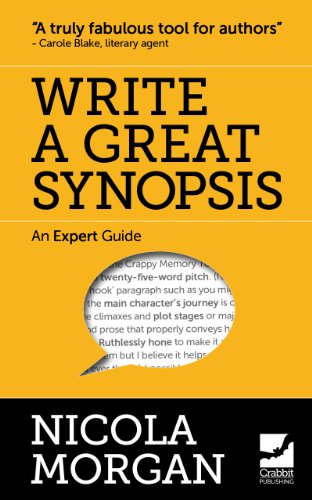
would suggest you look at Nicola Morgan’s book Write a Great Synopsis – An Expert
Guide. She goes into a lot of detail and it is accessible.
What I will say
you must do is: Always check on the agent’s website to check exactly what their
submission guidelines are, then adhere to them. They are not optional. If they
say a one-page synopsis that’s what you do. On the other hand, if they say two
pages or more that’s what you provide.
 In general, it is
suggested that the synopsis should be no more than one or two pages. What a
synopsis is not, is an outline or chapter breakdown. Instead, it tells the
reader what the book is about and gives the sense that the author has managed
to write a book with a complete narrative and an arc. The synopsis gives
details of the main characters and the main plotlines while not dealing with
minor characters and subplots. It should convey conflict and setting, themes
even the denouement while giving a sense of the voice.
Unlike, the
chapters which should be double spaced the synopsis can be single-spaced. Once
again it should have the title of your novel, who it is aimed at – middle grade/teen/YA
and that it is written by you. It should be in a clear font – something like Ariel
or Times New Roman – Point size 12. Don’t go smaller or they won’t be able to
read it. Neither have ridiculously small margins in order to cram as much
information into the two pages. Agents have seen it all before, and are not
going to be impressed, or tricked by it. They are looking for a well written,
concise and punchy synopsis that grabs their attention and informs them.
Do not be afraid
to repeat information that has been said in your covering letter. In fact, you
are almost guaranteed to do so, as you are likely to repeat your pitch. Avoid
rhetorical questions. It is better to answer all the questions you pose in your
synopsis. It should be written in the present tense even if your story is written
in the past tense. In the same way, it should be written in the third person
even if the story is in the first person while still getting across a sense of the voice and
feel of the story. If your story has multi viewpoints, ensure that you get this
across in the synopsis too. Most importantly though, ensure that there are no
grammatical or spelling mistakes throughout - proofread it carefully.
 |
| Get to the core of your story |
This is based on
Nicola Morgan’s method of writing a synopsis:
1.
Write your one-sentence pitch
2.
Expand it until you have
a paragraph that you might use as your pitch paragraph in your submission
letter (don’t be afraid to repeat information in synopsis and letter)
3.
Expand this by including
what happens at the end, show how the main character’s journey is completed. This
should give you two paragraphs.
4.
Then include climaxes and
plot stages or major obstacles. Add those into your paragraphs. You may want to
change the order for clarity. Hopefully, you now have at least a page.
5.
Connect them all together
with beautiful prose. Focus on the important information and avoid the unnecessary.
6.
Hone it to within an inch
of its life until it is ready for submission. Get others to look at it.

Don’t be afraid of
it. Yes, writing a synopsis is hard but if you know what is at the core of your
story it is much easier. Focus on that Think about what is really at the heart
of your narrative. Use that to help you write your pitch and your synopsis.
Books are rarely
rejected just because of a synopsis unless it is really badly written. Decisions
are more likely to be based on a combination of the idea as pitched in the
letter and the standard of the writing in the chapters. Some may suggest that
the synopsis really is the least important part of the submission; however, and
importantly, this does not mean you should not pay attention to it. Agents may
need it to back up your submission. They will read it in order to feel
confident that you really do have an idea that hangs together and that you can
show that you understand your narrative fully. You are highlighting through
your synopsis that this is a strong concept. They may also use it later when marketing
your book.
Good luck everyone
– you can do this!


 Posts


