Showing posts with label #writingtips. Show all posts

Sunday, 24 October 2021

Characterisation Inspiration

Ian McKellen
 Characters are the very life of fiction. As writers, we need to create characters that readers are going to care about and empathise with. They need to believe in them, so the characters need to come across as credible and fully rounded. 

Your setting will exist so that the character has somewhere to stand and it will help define them. You can use your setting to give clues about the character. For example, where they live gives you some hints about them - The squat vs the gated community. While the plot is more about the character discovering who they are, what their needs and wants are, in the process revealing to reader what they are really like. 

All sounds so straight forward really doesn't it? Or is it? So often I see characters in work I am giving feedback on that all sound the same and are one dimensional mean that the reader just doesn't engage with the narrative.

There are many ways and exercises you can do to get inside your characters head. For example: write a letter to you the author from the character introducing themself; answer various questions such what is their favourite music, what's in their pocket, what's their deepest secret etc.

However, I saw a really simple way to think about characterisation when I watched the brilliant actor, Ian McKellen, being interviewed by Graham Norton (Check it out on iPlayer Graham Norton Show, Friday 22nd October)  So simple in fact, it is obvious when you hear it, you wonder why you hadn't thought of it before. Sir Ian McKellen started off by pointing out how incredible it is that we are all different. Different faces, skin, hair, mannerisms, the way we walk, sit etc. He then went to show how he played two of his characters. Hamlet and his most recent one, Firs, in The Cherry Orchard. He did it purely by changing his stance in his chair. As simple as that. It was extraordinary. Hamlet was a young character where he sat up straight, while the other was an old man, so he stooped over. Just small details, but it makes a wealth of difference. 

Become a people watcher. Create a notebook where you take note of people's mannerisms, hair, the way they walk. All those small details that you can use to paint a three-dimensional picture of your character with them. It's not about info-dumping, it's about hints. The notebook will be a resource you can use throughout all your writing, not just one manuscript. Keep it is as a live document that continues to grow every time you see something. Create those brilliant characterisations just like Sir Ian McKellen did through observation.


Conan Gray - People Watching


Thursday, 26 March 2020

#writingishard7 - characters


So much has changed in two weeks. When I wrote my blog two weeks ago, we were not in lockdown. People weren’t fighting over loo rolls. How quickly life can change as we start living in
our dystopian fiction. I could imagine telling a student their story was too far fetched if they’d presented me with this idea!

I thought this week we’d talk about characters. Characters inhabit your story and need to be fully rounded so that your reader can empathise with them. You will have protagonists and antagonists. All of whom will need to have flaws, wants and needs. It is important to remember that any decision that the antagonist makes will be the right decision for them to make at that particular moment even if it is going to cause problems for the protagonist.

When you create characters you automatically think about the basics. You think about hair colour, eye colour etc etc. I often search for images of people that I think look like my character. I then keep
writing letters
them in a closed Pinterest board that only I can access. It helps me visualise them and as a reminder. I also write a letter from my character to me introducing themselves. It is a way of getting inside their heads.

When writing Flight, I learnt to look at the relationships surrounding the main character and for me, I suddenly realised that Jakob was only surrounded by males including the horses, which were stallions. It was only when Kizzy came on the scene that he had anything to do with women. This was really important as I needed him to be unsure how to behave in front of a girl, clumsy and almost threatened by the situation. It was one of his flaws. You need to be aware of the flaws as it those that make them fully rounded characters and not flat, two-dimensional characters.

Getting to know your characters inside out means you will know how your character will react in any given situation. It needs to be a realistic and appropriate reaction. In an extreme situation (and you do have to be brave to do this) I have gone out pretending to be my character to see what it would feel like. How would they view the world? It is about writing the height. How would the world appear to them? Important if you are writing a ten-year-old character or a fourteen-year-old character. The world is going to feel very different from the world that you see. The other thing you can think about is what would be in their pocket always? Their phone? A pebble? Sweets? Intriguing idea.

During this lockdown perhaps take this time to get to your know all your characters intimately so you
Social distancing
will know automatically know how they would react in any situation without having to think about it. Have some fun with it.

Stay at home. Stay Safe.

Thursday, 13 February 2020

#writingishard4 - Tenacity

Matt Haig
Notes on a Nervous Planet

If you are a writer, tenacity is certainly a prerequisite. Writing is hard. Also, it is very enjoyable and the best job ever a lot of the time, otherwise why would we do it? Whatever stage in your writing career you will need tenacity. Everyone’s journey, as an aspiring writer and/or as a published writer, is going to be different and personal to you. Consequently, it is important, as Matt Haig says, that you ‘Do not compare yourselves to others.’


It is worth also remembering that writing is a marathon, it is not a sprint. You might hear odd stories about people writing fast and being published very quickly. For a start, I’d say I bet they have done a whole lot of prewriting and that is why they could write fast, but they are just not counting it because it sounds so much better if you can say you wrote a book in a couple of months. Being published quickly is often the case of being in the right place at the right time (or being a celebrity!) The reality for most of us is very different. Writing takes time. A tweet I circulated recently said that according to Paul Graham, ‘The easy, conversational tone of good writing comes only on the eighth rewrite.’ To be honest I thought eight was a bit optimistic. More like twelve plus at least! Be prepared as well that it might take more than one novel. You may write several before you find the right one that really works. Flight was my fourth novel. The other three are unlikely to ever see the light of day, but I see them as my practice

novels. I learnt so much writing each one of them. When Flight was picked up, I had been writing seriously for over twelve years. (the photo shows a meeting where it was decided I should start submitting Flight. I was lucky I not only worked with Golden Egg Academy, but I was also mentored by Imogen Cooper)


Rewriting and editing can take a very long time and luxuriate in that first book when you do have time to dedicate to it. It’ll be a different situation after you have been picked up by a publisher. The deadlines will be a whole lot tighter and the chances are you won’t have so much time to write any subsequent books once you are published.


Once you have got a deal and a book out there, tenacity is still necessary. It might be linked to other elements of your life as a writer. Obviously, you will be writing your next book, but you are also going to be publicising/marketing your current book. Having a presence on social media, cultivating new audiences, potentially presenting at schools, literary festivals or undertaking library visits. It is all about juggling and ensuring you don’t become overwhelmed. See a recent post I did for the AwfullyBigBlogAdventure blog on remembering to enjoy your work.

Be kind to yourself. Writing’s hard, as I said, and the ‘journey’ can be a long and bumpy one, particularly if you are getting lots of rejections from agents and publishers. We’ve all been there, and it is really bruising. Allow yourself to grieve briefly each rejection. Then remind yourself it’s one person’s opinion and it only takes one person to say ‘Yes!’ Don’t be hard on yourself, see the rejection as part of the journey and something constructive. If you find in the rejection feedback that they all mention the same element as an issue/concern, then you know you need to address it. If, however, the feedback is all different, read it. Take it on board. Work on what you think is fair and relevant then move on to the next submission. One day you might be the one talking to aspiring writers about the number of rejections you got, as a badge of honour, and how you eventually got published. This photo is over a rejection letter I got a long time ago for a novel that when I look back
it is was nowhere near ready for submission. It is from my greatest friend, even though at the time we hadn’t met. That came later and that same person, Imogen Cooper, changed my life and the direction of my writing. 

Importantly, don’t give up. You can do this. The writing community is amazing and supportive. Find your tribe and talk to them. Understand that getting a book published is hard, but if you believe in your story, build that tenacity up


 Ness x


@VanessaHarbour


Thursday, 30 January 2020

#writingishard3 - Synopsis


 Writing is hard. And everyone’s journey is different. There is a TEDtalk doing the rounds at the moment, which tells a fabulous journey that happens to be a very quick writer’s journey. I just want to say don’t get disheartened by this. It doesn’t make you any less of a writer if your journey is longer. Writing takes tenacity. Have faith in your writing. You will get there.

The journey can be long...

 I have had a request from the ever-lovely Annaliese Avery. We all think writing a book is hard, but it is really easy in comparison to writing a synopsis. That is like pulling teeth. There is no definitive way to write a synopsis, but I am going to offer some suggestions to help you. I would suggest you look at Nicola Morgan’s book Write a Great Synopsis – An Expert Guide. She goes into a lot of detail and it is accessible.

What I will say you must do is: Always check on the agent’s website to check exactly what their submission guidelines are, then adhere to them. They are not optional. If they say a one-page synopsis that’s what you do. On the other hand, if they say two pages or more that’s what you provide.
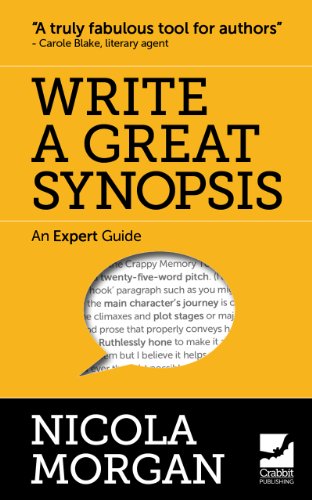
Image result for write a great synopsis - an expert guideIn general, it is suggested that the synopsis should be no more than one or two pages. What a synopsis is not, is an outline or chapter breakdown. Instead, it tells the reader what the book is about and gives the sense that the author has managed to write a book with a complete narrative and an arc. The synopsis gives details of the main characters and the main plotlines while not dealing with minor characters and subplots. It should convey conflict and setting, themes even the denouement while giving a sense of the voice.

Unlike, the chapters which should be double spaced the synopsis can be single-spaced. Once again it should have the title of your novel, who it is aimed at – middle grade/teen/YA and that it is written by you. It should be in a clear font – something like Ariel or Times New Roman – Point size 12. Don’t go smaller or they won’t be able to read it. Neither have ridiculously small margins in order to cram as much information into the two pages. Agents have seen it all before, and are not going to be impressed, or tricked by it. They are looking for a well written, concise and punchy synopsis that grabs their attention and informs them.

Do not be afraid to repeat information that has been said in your covering letter. In fact, you are almost guaranteed to do so, as you are likely to repeat your pitch. Avoid rhetorical questions. It is better to answer all the questions you pose in your synopsis. It should be written in the present tense even if your story is written in the past tense. In the same way, it should be written in the third person
Get to the core of your story
even if the story is in the first person while still getting across a sense of the voice and feel of the story. If your story has multi viewpoints, ensure that you get this across in the synopsis too. Most importantly though, ensure that there are no grammatical or spelling mistakes throughout - proofread it carefully.

This is based on Nicola Morgan’s method of writing a synopsis:

1.     Write your one-sentence pitch

2.     Expand it until you have a paragraph that you might use as your pitch paragraph in your submission letter (don’t be afraid to repeat information in synopsis and letter)

3.     Expand this by including what happens at the end, show how the main character’s journey is completed. This should give you two paragraphs.

4.     Then include climaxes and plot stages or major obstacles. Add those into your paragraphs. You may want to change the order for clarity. Hopefully, you now have at least a page.

5.     Connect them all together with beautiful prose. Focus on the important information and avoid the unnecessary.

6.     Hone it to within an inch of its life until it is ready for submission. Get others to look at it.
Don’t be afraid of it. Yes, writing a synopsis is hard but if you know what is at the core of your story it is much easier. Focus on that Think about what is really at the heart of your narrative. Use that to help you write your pitch and your synopsis.

Books are rarely rejected just because of a synopsis unless it is really badly written. Decisions are more likely to be based on a combination of the idea as pitched in the letter and the standard of the writing in the chapters. Some may suggest that the synopsis really is the least important part of the submission; however, and importantly, this does not mean you should not pay attention to it. Agents may need it to back up your submission. They will read it in order to feel confident that you really do have an idea that hangs together and that you can show that you understand your narrative fully. You are highlighting through your synopsis that this is a strong concept. They may also use it later when marketing your book. 

Good luck everyone – you can do this!