Showing posts with label Nicola Morgan. Show all posts

Thursday, 30 January 2020

#writingishard3 - Synopsis


 Writing is hard. And everyone’s journey is different. There is a TEDtalk doing the rounds at the moment, which tells a fabulous journey that happens to be a very quick writer’s journey. I just want to say don’t get disheartened by this. It doesn’t make you any less of a writer if your journey is longer. Writing takes tenacity. Have faith in your writing. You will get there.

The journey can be long...

 I have had a request from the ever-lovely Annaliese Avery. We all think writing a book is hard, but it is really easy in comparison to writing a synopsis. That is like pulling teeth. There is no definitive way to write a synopsis, but I am going to offer some suggestions to help you. I would suggest you look at Nicola Morgan’s book Write a Great Synopsis – An Expert Guide. She goes into a lot of detail and it is accessible.

What I will say you must do is: Always check on the agent’s website to check exactly what their submission guidelines are, then adhere to them. They are not optional. If they say a one-page synopsis that’s what you do. On the other hand, if they say two pages or more that’s what you provide.
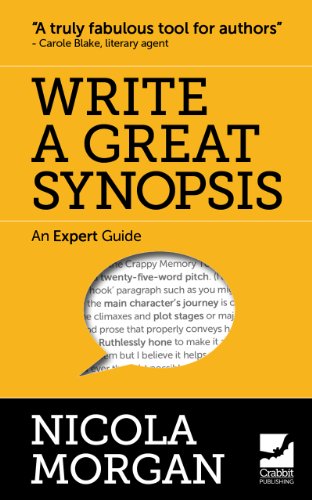
Image result for write a great synopsis - an expert guideIn general, it is suggested that the synopsis should be no more than one or two pages. What a synopsis is not, is an outline or chapter breakdown. Instead, it tells the reader what the book is about and gives the sense that the author has managed to write a book with a complete narrative and an arc. The synopsis gives details of the main characters and the main plotlines while not dealing with minor characters and subplots. It should convey conflict and setting, themes even the denouement while giving a sense of the voice.

Unlike, the chapters which should be double spaced the synopsis can be single-spaced. Once again it should have the title of your novel, who it is aimed at – middle grade/teen/YA and that it is written by you. It should be in a clear font – something like Ariel or Times New Roman – Point size 12. Don’t go smaller or they won’t be able to read it. Neither have ridiculously small margins in order to cram as much information into the two pages. Agents have seen it all before, and are not going to be impressed, or tricked by it. They are looking for a well written, concise and punchy synopsis that grabs their attention and informs them.

Do not be afraid to repeat information that has been said in your covering letter. In fact, you are almost guaranteed to do so, as you are likely to repeat your pitch. Avoid rhetorical questions. It is better to answer all the questions you pose in your synopsis. It should be written in the present tense even if your story is written in the past tense. In the same way, it should be written in the third person
Get to the core of your story
even if the story is in the first person while still getting across a sense of the voice and feel of the story. If your story has multi viewpoints, ensure that you get this across in the synopsis too. Most importantly though, ensure that there are no grammatical or spelling mistakes throughout - proofread it carefully.

This is based on Nicola Morgan’s method of writing a synopsis:

1.     Write your one-sentence pitch

2.     Expand it until you have a paragraph that you might use as your pitch paragraph in your submission letter (don’t be afraid to repeat information in synopsis and letter)

3.     Expand this by including what happens at the end, show how the main character’s journey is completed. This should give you two paragraphs.

4.     Then include climaxes and plot stages or major obstacles. Add those into your paragraphs. You may want to change the order for clarity. Hopefully, you now have at least a page.

5.     Connect them all together with beautiful prose. Focus on the important information and avoid the unnecessary.

6.     Hone it to within an inch of its life until it is ready for submission. Get others to look at it.
Don’t be afraid of it. Yes, writing a synopsis is hard but if you know what is at the core of your story it is much easier. Focus on that Think about what is really at the heart of your narrative. Use that to help you write your pitch and your synopsis.

Books are rarely rejected just because of a synopsis unless it is really badly written. Decisions are more likely to be based on a combination of the idea as pitched in the letter and the standard of the writing in the chapters. Some may suggest that the synopsis really is the least important part of the submission; however, and importantly, this does not mean you should not pay attention to it. Agents may need it to back up your submission. They will read it in order to feel confident that you really do have an idea that hangs together and that you can show that you understand your narrative fully. You are highlighting through your synopsis that this is a strong concept. They may also use it later when marketing your book. 

Good luck everyone – you can do this!


Saturday, 17 January 2015

Agents and Editors...they are human beings you know!

Sometimes the way writers behave really embarrasses me and they give  the rest of us a bad name. I have to say they are often the inexperienced ones.  I am Facebook friends with the wonderful Carole Blake of Blake Friedmann. She will occasionally regale us with tales of recalcitrant aspiring authors who have not read the detailed submission guidelines on the agency's website or have not taken kindly to her rejection and something she wrote recently made me think I ought to write this post.

Before you all shout at me I do also know that some agents may  behave a little badly too with their rejections but today I am not talking about that. I will deal with that in another post.

Firstly those awful letters/emails. Some of which come across as almost threatening! And this is the point that I have to thank Carole for. Do not respond to any rejection email while drunk. It is not clever. You have no hope of ever being able to send anything else ever to that agency/editor again if you send a rude and abusive email to them. Never say anything in an email you wouldn't be willing to say face to face. Always be polite and considerate.

Nicola Morgan has written some excellent books offering guidance as well as Carole Blake's own book, From Pitch to Publication(Macmillan), which she is currently writing an a new version of. As well, of course, check the submission guidelines on any agency/publishers website and adhere to them. They are there for a reason.

But then there is also face to face and that can be really cringeworthy. I am talking about those people, and come on you have all seen them or heard them haven't you, who pin a potential agent or editor in the corner giving them no hope of escape while telling them every single detail of their book even if it is not finished or appropriate for their agency/publisher because the aspiring author hasn't checked who they are. Shouting at them 'Oh you must read it, you'd love it, I know you'll want to take me on. I'd be so easy to work with.Shall I give you my number, or I know shall I ring you tomorrow? Can I have your card.' This is all said without taking a breath and without the agent/editor being able to get a word in edge-ways.  I have seen it happen at conferences, other people's book launches and most unforgivable parties where the poor agent/editor has actually gone to have a social life with people who have nothing to do with books necessarily.

What I am trying to say in possibly a rather long winded way is respect these people. They are human beings. If you are going to an event where you are know they are going to be in attendance. Find out about them (Check out websites and the Writers' and Artists Yearbook if you don't know where to look) and just talk to them.  Have a normal conversation. There is a good chance when they find out you are a writer they will ask you about your work and then you have an opportunity to give your brief (note that word BRIEF) elevator pitch. If they are interested they will ask more. If not don't push it, don't keep harping on about it thinking you can convince them. Leave the subject alone and move the conversation on. Don't let them think you were only talking to them because they were agents/editors. How shallow and rude is that?

Most importantly be an interesting writerly person who leaves a good impression. And for all writers there is always going to be another mountain but we will always make it through...


Saturday, 23 August 2014

Adhere to submission guidelines - they do apply to YOU!

I am going to write about a pet hate of mine and I am sure that of many agents and publishers out there. I know I have mentioned it previously on a post but I am going to mention it again because it is important and it is REALLY irritating when people can't be bothered.

What is it? I hear you ask. It is nothing ground breaking. It is nothing that difficult or complicated. Firstly please when thinking about submitting your manuscript anywhere ensure it is the best it possibly can be. Don't think, it's ok you'll make it better once they've taken it on. It doesn't always work like that. You may not get a chance and you may have blown an opportunity. I would like to hope with Golden Egg Academy you want to submit the best thing you can. If you submit something half hearted it often comes across in the writing. If you don't care about it why should we?

Submission guidelines are there for a reason and yes we do notice and mind if you flout them. What happens is we probably just won't bother reading that extra chapter that you have tried to squeeze in on the end of the third chapter. Or the three chapters you  have included in each chapter submitted on line so you appear to have actually submitted six chapters. I know there are going to be people saying 'but my story doesn't get going until chapter 4 or chapter 5'. Well I know a lot of readers (children in particular) who will not wait until chapter 4 or chapter 5...The story needs to grab our attention early on.

If it asks for a synopsis make sure it does the job. Tells us the age range you are aiming for if you are writing for children. I often get the feeling if someone doesn't include that it is because they don't know and they probably don't really understand their story because of it. It shows. We will know.

Most importantly (and again) follow the guidelines on what sort of synopsis is required, if there aren't any don't use that as an excuse to put a ten page breakdown in. Be professional, show what a great person you would be to work with. Don't waffle and don't worry about giving away the ending that's what you do in a synopsis. Quick tip: Read Nicola Morgan's excellent book on how to write a synopsis.

That's it, that's all I have to say. ADHERE TO THE GUIDELINES. DO WHAT IT SAYS. Yes they do apply to YOU.

Slightly drug filled post this week as am now truly bionic having had my second knee replaced. Perhaps that is why I am feeling so intolerant of people and their inability to adhere to guidelines. However it has been a good week with lots of good news for people I know and I was sent this song by the wonderful Eggers while I was in hospital and it is certainly true. Such a great community to be part of


Wednesday, 14 August 2013

Who needs labels?

Too many labels!
We all know about young adult fiction. We were then introduced to New Adult which was supposed to piggy back on the success of Fifty Shades of Grey and its erotica. It included stories aimed at the upper age range of YAF right into the early twenties. But now, today, I have heard of another label. This time it is called Clean Teen! This is apparently 'sophisticated stories for the NA market but without the sexualised content.'

Does this mean that neither YAF or NA can be sophisticated? Who decides?

For me what they are forgetting to mention all the time is that whatever age you are you want good stories told well. Stories that interest you and deal with issues that may concern you or amuse you. You may be particularly keen on romance or crime, it may be Sci Fi or Fantasy that tickles your fancy. Or you might enjoy a good war story or a bit of sick lit (that's a whole other issue). But at the end of the day it doesn't matter as long as you are enjoying reading it.

All these labels at the end of the day mean nothing. They are just labels. Some are being conveniently used to raise the profile of certain books but most people don't actually care what label a book comes under. They care about whether the writing is any good and the story is enthralling.

As a writer I would suggest you don't worry about them either. Write the story you want to write to the best of your ability. You may find yourself shoehorned into a label at a later date but forget about it until it happens. Concentrate on honing your craft as a writer. Making your story come to life and lift off the page, sucking the reader in so even when they put the book down they are still thinking about it.

When writing for teenagers/young adults/new adults/clean adults (whoever) I would suggest you think about what Nicola Morgan has previously said: 'I believe teenagers want….stories that take them out of the comfort zone (and definitely out of their parents’ comfort zone), to the limit of fear, disgust, emotion, grief, or passion, and which then brings them safely back again'

Therefore my tip for today is - just go away and write and forget about labels!

One talented teenager:

Tuesday, 16 April 2013

Exclamation Marks!!!!!!!!!!!!!!!!!!!!!!!!!!!!!!!!!!!!!!!!!

Exclaimed out
This is just a quick post but I have just been drowning in exclamation marks. I have recently marked an assignment that was only 2,000 words long but had 70 (yes that is seventy) exclamation marks in it. And yes, I was sad enough to count them but that is because I became so distracted by the fact that virtually every sentence was ended with one. A cardinal sin as far as I am concerned particularly when writing for children, which this piece was.

For me exclamation marks should be used sparely for added impact. They should be used when you want to shout about something happening. If, however, you fill your piece with them their impact becomes diluted.

Oxford Dictionaries state that 'the main use of the exclamation mark is to end sentences that express: 

  • an exclamation: Ow! That hurt!
  • direct speech that represents something shouted or spoken very loudly: 'Look up there!' she yelled.
  • something that amuses the writer: Included on the list of banned items was 'crochet hooks'!
  • An exclamation mark can also be used in brackets after a statement to show that the writer finds it funny or ironic: She says she’s stopped feeling insecure (!) since she met him.
But even then I would be careful where you use them. I am really going to think about when to use them from now onwards. I had become blinded to them but now I realise how irritating they can become as I read this piece. 

For a start it made me think about the number of times when you are doing an email or a facebook post and you use thousands of exclamations (I am prone to exaggeration by the way) or lots of smiley faces or kisses.

There was a brilliant facebook thread started by Nicola Morgan who had sent a text to her plumber, I think, with a kiss at the end of it by accident. The conversation was full of wonderful examples of cringe making accidental kisses. I occasionally get them from students. I am sure they are harmless but sometimes they can make you feel quite uncomfortable.  But I am equally as guilty. I think it is all related to the fact we often hold conversations via a computer screen or a phone screen rather than face to face so you need to get nuances across and ensure the person the other end doesn't take offence.

Anyway that is off topic, back to the poor old exclamation mark. As I said this was to be a quick post and I am not asking you to never use the exclamation mark when writing but just to think about it. Make sure it has real impact and the reader can concentrate on the story and not the ever breeding exclamation mark!!!!!!!!! (sorry had to be done ;-)  and the smiley face...oh and perhaps a kiss xx)

I heard a snippet of this lady this morning and it made me smile. Here is one of my favourite, if poignant, songs.


Friday, 10 August 2012

Synopses and Letters to Agents

You put the final full stop on your manuscript that you are sure you have polished and polished to within an inch of its life and, therefore, you are now ready to send it out to prospective agents and publishers, when it hits you - BAM! You have to go through that tortuous process of writing the synopsis and the all important agent/publisher's letter. We all know how important it is to get these right because they are both things that can encourage said publisher or agent to look at your manuscript. The pressure is on.

However, help is at hand, Nicola Morgan has recently publishes her latest book Dear Agent. It is available for download in various places including Amazon. This is the latest in Nicola's collection of books aimed at helping the aspiring writer. She has also written Write to Be Published  and Write a Great Synopsis. I would recommend every single one of them and do so quite frequently. She offers sensible advice that is easy to follow. You still have to do the writing but Nicola, very cleverly, makes you feel like she is holding your hand as you go through the process. She makes you stop and think, asking questions of yourself and your writing. She is reassuring yet realistic in her approach. In Dear Agent Nicola gets down to specifics, for example there are chapters on your introductory paragraph, the hook paragraph, the wonderfully named cook paragraph - which is where your self - and then the final paragraph. All of which make you think very carefully about you and your manuscript and what information you want to get across. This along with Write a Great Synopsis backs up what she said in Write to Be Published but they also go into more detail. Using Nicola's books all together and following her advice means that you are well prepared when it comes to sending out that precious manuscript. It is well worth following her blog too, which is full of useful tips and ideas: http://helpineedapublisher.blogspot.co.uk/

Why should we believe what Nicola Morgan says I can hear you ask? It is quite simple, because she knows what she is talking about. As well as her non fiction, Nicola has written numerous excellent pieces of fiction. Her book, Wasted, is a perfect example and a book I used in my PhD research. It was also a book I used in one of my modules where the students where expected to do an author study. Nicola was incredibly generous with her time and willingly gave the students so much information. They were absolutely thrilled and took so much away from the encounter. I have recently downloaded her book Mondays are Red and am looking forward to getting into that too.

Here's Newton Faulkner's Pulling Teeth because sometimes writing feels like that, plus it comes from a new favourite cd:

Friday, 18 May 2012

Submitting to literary agents and publishers

This week I noticed on Facebook one of my former students was going through the angst of submitting his work to an agent (at the agent's behest I should add). Oh how I could empathise with his tortured statuses. That moment you decide your work is ready to be submitted is gut-wrenching. In my own experience the mouse has floated over and then away and then back to the 'send' button over and over again, until in a fit of 'just get on with it' clicking the button and watching the email with attachment fly away. Only to regret it immediately. Can't I have it back? Just one more look over it....damn. It used to be (and sometimes still is) the case of walking round and round the letter box. Thick envelope neatly prepared and stamped weighing heavily in your hands. At least now it is done in the privacy of your home rather than risking being arrested for stalking said letter box.

But then the next stage of angst starts. The wait. It could be days, weeks, months. Previously, a rejection was always preempted by that rather particular and distinct thwack as your returned, possibly unread, MSS hits the floor having been forced through the letter box by a potentially grumpy postman. These days it is almost more tortuous. As with every PING - 'you've got mail!' has the potential to end your dreams. But it is not the end of your dreams. It might be a hiccup in them but it might also just be a....'could we see more.' You just never know and you need to be prepared. It will happen, have faith.

Going back to making that decision when to submit there is actually always that risk that you don't get round to submitting because you keep thinking 'I will just give it one more proof read, edit, polish, rewrite, then it'll be ready.' Sometimes you have to be brave and let it go. It feels a bit like leaving your child on their first day at school, you don't know what's happening. Do they like it? Do they hate? Are they just sitting in the corner waiting (to be read)? But it is all part of being a writer. Perhaps there is a masochistic streak in all writers and that's why we do it.

Having listened to several agents and publishers and their thoughts on submissions I would like to give you some things to think about when submitting.

1. Read the Writers & Artists Year Book (other books are available). If in there (or on their website - another good place to check) it says they are not receiving unsolicited or unagented MSS. That does apply to YOU. They won't make a special case just because it is you. UNLESS they have personally invited you to submit in which case you need to state this clearly in your letter.

2. Read their submission guidelines. These are available on agents websites. Read them and adhere to them. Your story is not ready if you think you have to attach an extra couple of chapters because the story doesn't get going until then and they will miss your favourite bit.  If they want a two page synopsis - don't send them a ten page one  because you can't get it into two (and in the meantime read Nicola Morgan's excellent book on how to write a synopsis)

3. Now this is a tip coming from me, but am sure a few agents and publishers might agree so thought I would add it in. It is something I come across when marking, which I see as a kind of practice submission. (And obviously applies when submitting hard copy) Do not leave your MSS in your kitchen where you are cooking highly aromatic dishes(can you call cottage pie and chips aromatic?). It is revolting to have that smell waft at you the whole time you are reading and you turn a page. Do not let your cat/dog/child walk over it leaving muddy paw prints, however cute they are. The same with coffee or tea or unmentionable and indefinable stains.
Don't think you are safe when submitting on line - make sure you have removed track changes and comments. It is amazing what you can find out when someone hasn't!

4. And going back to point one really. If a publisher or agent has invited you to submit make sure you address it to them and mention in the letter that they had invited you. Saying where and when you met and the invited was handed out is always a good bet  in order to jog their memory. However, memorable you think you are you have to remember they see lots of people.

OK that's it, 4 Ness tips to help you with that angst moment of sending your work off. Go on, be brave, you can do it. You never know what might happen and good luck with it.

Happy Weekend and here's a piece of music because I always tried to play my guitar like this...and failed. Carlos Bonell and Strawberry Fields